Research
We conduct a variety of research topics in quantum physics and chemistry. Our ultimate goal is to bring quantum research to real world applications!


Representative papers

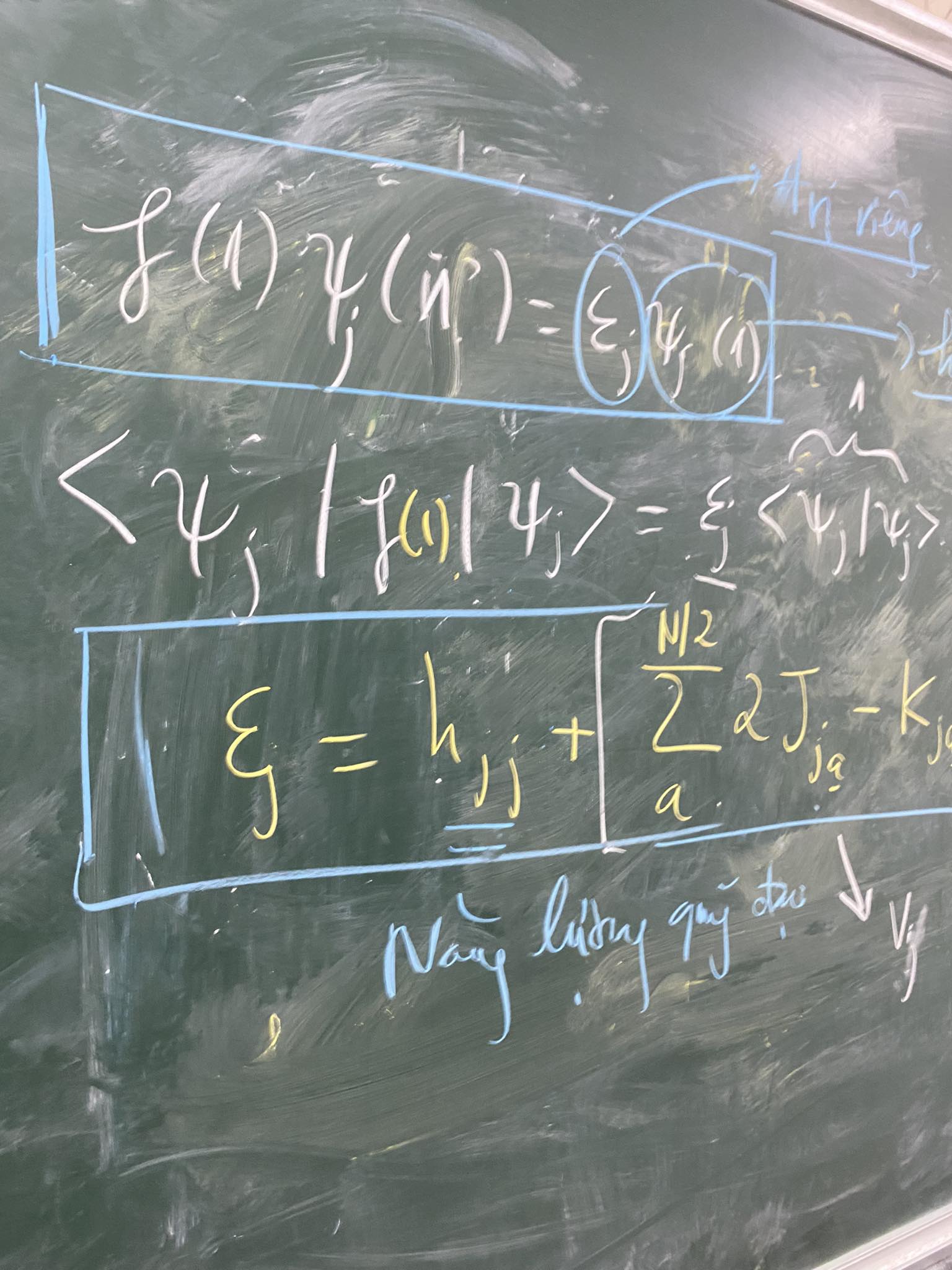
Attaining high accuracy for charge-transfer excitations in non-covalent complexes at second-order perturbation cost: The importance of state-specific self-consistency
Intermolecular charge-transfer (xCT) excited states important for various practical applications are challenging for many standard computational methods. It is highly desirable to have an affordable method that can treat xCT states accurately. In the present work, we extend our self-consistent perturbation methods, named one-body second-order Møller–Plesset and its spin-opposite scaling variant (O2BMP2), for excited states without additional costs to the ground state. We then assessed their performance for the prediction of xCT excitation energies. Thanks to self-consistency, our methods yield small errors relative to high-level coupled cluster methods and outperform other same scaling (N5) methods, such as CC2 and ADC(2). In particular, O2BMP2, whose scaling can be reduced to N4, can even reach the accuracy of CC3 (N7) with errors less than 0.1 eV. This method is thus highly promising for treating xCT states in large compounds vital for applications.
Read more...
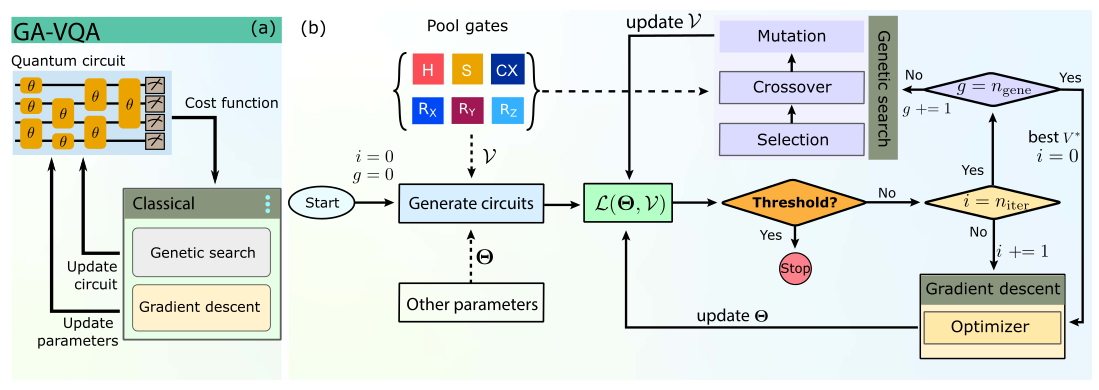
Multi-target quantum compilation algorithm
Quantum compilation is the process of converting a target unitary operation into a trainable unitary represented by a quantum circuit. It has a wide range of applications, including gate optimization, quantum-assisted compiling, quantum state preparation, and quantum dynamic simulation. Traditional quantum compilation usually optimizes circuits for a single target. However, many quantum systems require simultaneous optimization of multiple targets, such as thermal state preparation, time-dependent dynamic simulation, and others. To address this, we develop a multi-target quantum compilation algorithm to improve the performance and flexibility of simulating multiple quantum systems. Our benchmarks and case studies demonstrate the effectiveness of the algorithm, highlighting the importance of multi-target optimization in advancing quantum computing. This work lays the groundwork for further development and evaluation of multi-target quantum compilation algorithms.
Read more...